
I recently attended a public presentation on Bonds, Levies, and Elections at Wooster high school.
On April 15th the League of Women Voters hosted a presentation by the Wayne County auditor and director of the Board of Elections.
While the meeting was for all Wayne County I only had time to pay attention to the topics for Wooster.
Here are my impressions by topic.
Items on the May Ballot –
First, we will vote on Statewide Issue 2.
This would renew the State’s ability to issue bonds for infrastructure projects, this ability needs renewed by voters every 10 years.
This is not a bond by itself but rather voter permission to issue bonds.
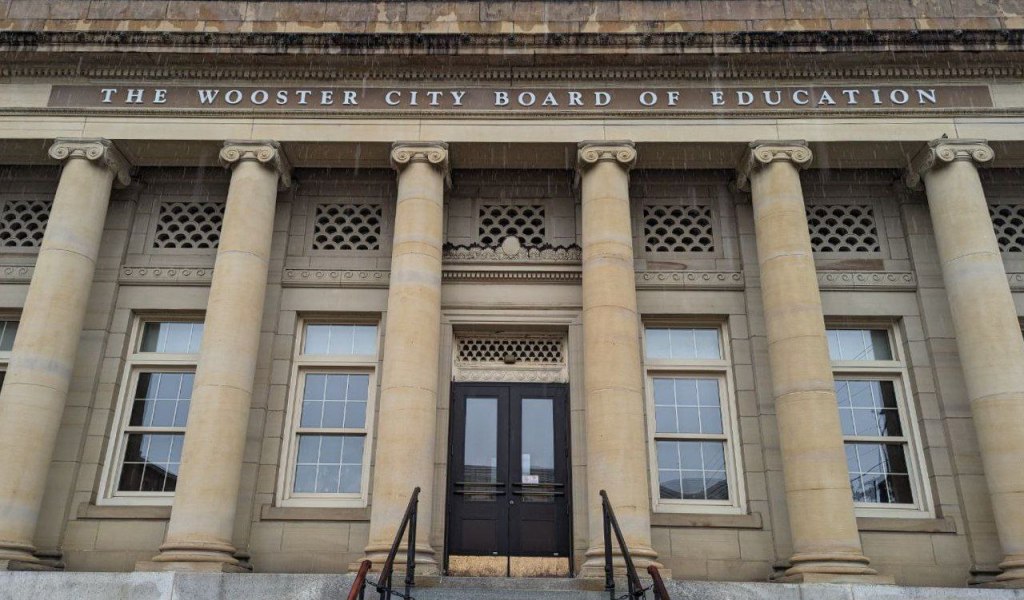
The second item is a Bond and Fixed Sum levy for the Wooster city schools for the purpose of the middle school building project.
This would be for issuing a $67 million Bond and raise a property tax levy of 3.4 mils to pay that Bond back over a 36 year term.
The cost to property owners would be $119 per year for each $100,000 of Appraised Value of their property.
Key Tax Words and Concepts –
For any examples here I will be using my own property.
I highly recommend the Wayne County auditor’s website.
If you want to follow along with any of my examples enter “735 Beall” into the property search bar at the top right of the site.
First, let’s start with what a mil even is.
A mil is 1/1000th of any value it looks at.
You can also think of this as 0.1% of a value.
So if you are taxing $1,000 then 1 mil of tax charges you $1.
A property tax rate of 1,000 mils would collect the entire Assessed Value of a property every year.
So what value do the mils look at when they are taxing?
That is sort of confusing.
You would think it is the value of your property.
The problem is there are two different terms to know here, Appraised Value and Assessed Value.
Appraised Value is how much you might sell your house for, give or take the market at any given time.
You can see mine at the top of my parcel entry labeled “Appraised $95,630.”
But this isn’t the value that gets taxed.
The Assessed Value is usually 35% of the Appraised Value.
If you scroll down to the blue heading labeled “Valuation” on my parcel you will see that my Assessed Value is only $33,470 which is 35% of my Appraised value of $95,630.
This smaller value is what is taxed.
We can double check this with the proposed bond levy by scrolling back to the top of my parcel on the auditor’s site.
There at the top is information about the proposed levy including the mils [3.4] and how much my yearly taxes would increase [$113.80].
So let’s do the math:
My Assessed Value × Number of Mils ÷ 1,000 [to make the mils thousandths] = My Share of the Bond Levy Tax
$33,470 × 3.4 ÷ 1000 = $113.80
When we pay property tax we only pay taxes on 35% of what we might expect to sell our property for, so that is nice I guess.
That is called the Assessed Value.
When communicating how much we will pay for the bond levy both the school district and the auditor’s office will refer to our Appraised Value because we are more familiar with that number.
So you will see communications saying the tax increase for the Bond levy will be $119 per year per $100,000 Appraised Value.
The Difference Between Fixed Rate Levies, Fixed Sum Levies, and Bonds –
A Fixed Rate levy is what most of us think of when we think about taxes.
These take a certain number of mils as a tax rate.
When our property values were redone in 2023 they went up 35% on average.
That means a Fixed Rate tax that collected $1.00 before would collect $1.35 afterwards.
The Rate doesn’t change, the Sum collected does.
The vast majority of our taxes are Fixed Rate and they typically fund things like police, fire department, and operating costs of schools and libraries.
Fixed Sum levies are the opposite.
These are set to collect a certain amount each year.
When our property values went up in 2023 any of the Fixed Sum tax rates needed to be adjusted down so they would still only collect the same amount.
So if a levy had been fixed to bring in $1,000,000 before at a rate of 3 mils when our property values went up 35% it would need to be adjusted down to 2.2 mils and would still collect only $1,000,000.
The Rate changes to collect the same Sum.
This kind of levy is used sometimes for libraries, emergency funds for school districts, and to repay Bonds for building.
Ok, so what is a Bond?
A bond is a debt that an entity like a school district takes out to get a large amount of money upfront to do things like building projects.
The debt must then be repaid over a set term of years.
This is why Bonds issues usually include a Fixed Sum levy for voter approval.
The debt is to be repaid in regular chunks broken up to be equal over the life of the loan.
So by using a Fixed Sum levy a school district can ensure they can cover those payments without taking more from the taxpayers than needed.
Why levies keep happening –
I have done another piece on this that I will link in the comments but here is a short summary.
In Wooster the amount the schools get in funding from property tax goes down over time due to inflation and increased property value.
A State system ensures this is the case and its intention is to keep the school district coming back to voters over time.
This can also happen if a levy expires after a set time and needs to be renewed.
Another thing that can happen is a replacement where the reason for the levy is the same but the rate is reset if it has gone down, usually for Fixed Sum levies.
Community Q&A –
Why doesn’t the school district levy an income tax instead of a property tax to build buildings?
The amount collected from income tax can go up and down considerably.
That makes it a poor match to the constant payments of equal value needed to repay a loan.
However, an income tax would distribute the burden of the tax differently and would ease that burden on fixed income residents.
Will the length of the bond levy in years be printed on the ballot?
Yes, it will include the amount, tax increase per $100,000 property Appraised Value , the length of the term in years, the start date, and the first collection date.
Is the Ohio State issue on the ballot a Bond and why doesn’t it have the same information?
The Ohio Issue 2 is not a Bond.
Think of a Bond like one of us going to the bank for a mortgage or car loan.
A levy would then be like us getting a job to get the steady income to pay for those loan payments.
Issue 2 is not Ohio going to the bank, it is getting permission to go to the bank at all in the first place.
Without this voter approval every 10 years, Ohio cannot issue Bonds for infrastructure projects.
That is all we are deciding with Issue 2 so there is no cost or term or other information.
Is it more expensive to use a Bond to pay over time rather than pay all up front?
Yes, always.
For example, for a $67 million Bond over 36 years and an average interest rate of 5% we would end up paying around $145 million once it was all paid off, $67 million in principle and $78 million in interest paid.
It would be cheaper if you paid the $67 million up front.
However, with the Bond you only have to pay about $4 million every year for 36 years.
Where can the public find descriptions of the issues, for/against arguments, and sample ballots?
For all of these the Wayne County Board of Elections site has these.
I will link it in the comments.
The League of Women’s Voters also hosts full text and for/against arguments for State issues on their website, link in comments.
Where can the public find how much they will pay on the proposed levy, how much they pay now, and where their tax money is going?
The auditor website, which in my opinion is shockingly good, has all of this information.
I have been using examples from my own parcel plot on this site.
You can put your own address in the top right search area to pull up your own information for each of these questions and more.
I will say that you must drop “Street” or “Avenue” or “East” etc.
So our courthouse’s address is 107 West Liberty Street.
To put it into the auditor’s search bar you would just use “107 Liberty” and select the plot for 107 Liberty and not 1070 Liberty.
That is it for the presentation.
For anyone interested in more information, I will be having a space at the Wooster public library on May 1st in Meeting Room 1 from 6pm to 7pm if you have questions on anything I have written lately.
Anyone is welcome to drop in.


 Wooster Interpreter
Leave a comment