
I have looked at the data from the last 5 years of elections for Wooster.
For November elections voter turnout averages about 50% of all registered voters.
Presidential elections boost this to about 75% turnout.
Very off year November elections with only local and county elections can sag down to about 25% turnout.
For May elections, maximum voter turnout is only about 25%.
Voter turnout in November is usually double what it is in May, every 4 years it is closer to triple.
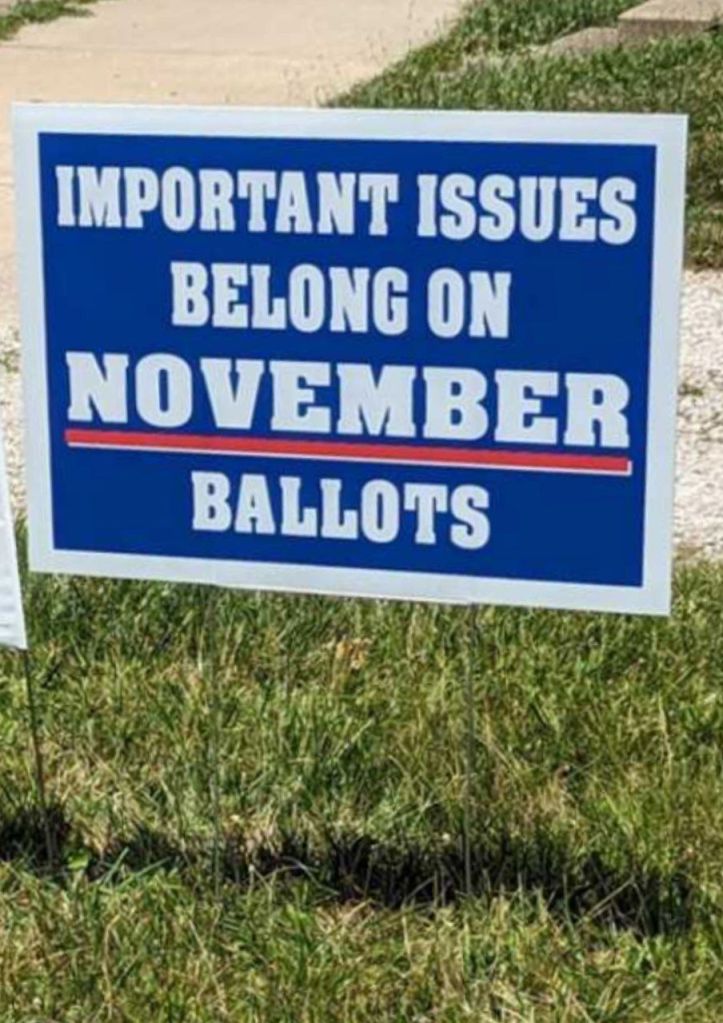
That is why I strongly believe that important issues belong on November ballots so they can be decided by as many voters as possible.
I believe that so much that I paid to have a sign printed to say exactly that a few years back.
Don’t local issues get drowned out by contentious Federal or State elections though?
The data says no.
I checked the Wooster local and county issues to see if people weren’t voting on them during busy election years.
I found that if a person steps up to a voting machine they will vote on local and county issues about 95% of the time.
The lowest participation from voters I could find was 86% and that was for the legal details of amendments to Wooster’s charter.
Almost everyone that is voting at all is taking the time to vote on local issues
Ok, so people vote, but aren’t they just going down the ballot and voting without paying attention?
Again, the data says no.
Wooster voters seem to be very capable of delivering different answers on different local questions even when there are many of them to consider.
I found 3 cases in the past 5 years where multiple local issues were on a November ballot.
I think each demonstrates something important.
Example 1: Renewal vs Renewal and Increase
In November 2022, voters were considering both a simple renewal for children’s services and a renewal and increase for the library.
Voters approved the renewal by 68% but only approved the renewal and increase by 54%.
That is a 14 point difference in voter reaction.
To me this demonstrates the voters accurately understand what is on a ballot.
This election saw a 53% turnout of all registered voters.
Of the 53% that turned out 97% voted on both of these local issues.
Wooster voters are paying enough attention to treat different local issues differently.
Example 2: Legal Details
In November 2020, the depths of covid lockdowns, voters considered amendments to articles of the Wooster city charter.
These were presented in 5 separate issues to approve or disapprove.
These all passed with anywhere from 82% to 66% approval.
Again, voters showed a strong, 16 point, difference in voter reaction.
Turnout was 66% of all registered voters.
86% of those that voted answered all 5 questions, 90% answered at least one.
Neither the rates of voter participation nor the magnitude of approval followed the order in which the issues appeared on the ballot.
Wooster voters are patient enough to not get bored, frustrated, or overwhelmed even when presented with 5 different local issues involving legal details.
Example 3: Separate but Linked Issues
In November 2023, voters were asked whether the city should offer aggregate electrical and gas plans each option was on the ballot separately for approval.
These 2 issues were extremely connected, so if voters were not paying attention and just voting chaotically then there should be about a 15 point difference in voter reaction just like in the above examples.
That did not happen.
Electric and gas aggregation were approved by 69% and 70% respectively, only a 1 point difference in voter reaction.
Turnout was 47%, 91% of those voting answered both questions.
These issues were strongly connected and the voters correctly treated them as such.
Wooster voters are not voting chaotically and will give identical answers to connected questions.
I was not expecting to find that Wooster voters were quite this detail oriented.
But these data are clear, Wooster voters can be trusted to vote on local issues with discernment in November elections.
This effect is strong even when elections are steeped in Federal contests, bogged down in legal details, and even in the depths of covid lockdowns.
I am truly impressed.
What Wooster voters don’t do is vote in May elections much above a 25% turnout.
This dive into the data has only further convinced me that important issues must be placed only on November ballots.
To do otherwise is to have these important issues decided by only a small but active minority of voters.
Is it the unengaged voter’s fault for not voting in May?
Technically yes, I know of no force keeping them from voting in May vs November.
However, I am not comfortable disenfranchising half to two thirds of likely voters for the crime of being busy.
Yes, it is the voter’s responsibility to vote.
It is also the responsibility of those seeking voter input to set voting conditions to involve as many people as possible.
I do not trust May elections to do that for Wooster.




Leave a Reply