WHEN YOU SEE THESE ARROWS: YOU CAN CLICK TO SEE MORE DETAILS
CLICK THE SAME ARROW TO CLOSE THEM By keeping details behind these expandable arrow sections I hope the main article can be read as a summary that still hits all the main points.
On October 13th the Wooster school board was presented the results of the Ohio State report card for the 2024-2025 school year. After the presentation I took a deep dive into the data and results. I wanted to get a better picture of the results and how our school district is doing over time. I had hoped to have this piece out for Thanksgiving but a question I had about the report card delayed it last minute. Still, there is a bit of good news to share and I hope we still read it in the spirit of being thankful.
The picture over time is harder to judge because there are only 3 years to compare.
The Covid lockdowns made any meaningful testing impossible and cast a long shadow. It isn’t until the 2022-2023 school year that testing data can be fully collected and reported again.
Here I will summarize my understanding of the district and the results in plain terms. The details and my reasonings will be behind the expandable arrow sections.
Wooster is doing better than Ohio’s standards and is doing the best it has since the covid lockdowns.
Wooster’s school district was graded 4 out of 5 Stars in 2024-2025. Wooster had been earning 3.5 Stars since report cards resumed. The more detailed scores show small improvements each year.
Ohio watches the schools to try to make sure six things are happening: That students are performing at grade level. That students are improving each year. That students with different backgrounds are being equally served. That Kindergarten through 4th graders are learning to read. That students are successfully reaching graduation. That students are ready for the future after graduating.
School districts are graded on each of these goals separately.
Our students are doing as well as Ohio expects on State tests. They have been improving a little bit each year.
Wooster scored 3 out of 5 Stars on Achievement. This is the same score it has had for the last three years. The detailed scores show a small improvement each year.
Our student’s progress for each year is better than Ohio expects. This is a noticeable jump from previous years.
Wooster scored 4 out 5 Stars on student Progress. This is a jump from a score of 3 Stars for the previous two years. The detailed scores are complicated statistical measures so I will do my best to interpret them. From the State’s point of view, Ohio went from feeling vaguely sure Wooster was having a small student growth to being very sure Wooster was having solid student growth.
Our students with different backgrounds are performing far more equally than Ohio expects. This was also how Wooster was 2 years ago but last year’s score had dropped a bit. This is a return to doing extremely well.
Wooster scored 5 out of 5 Stars on Gap Closing. The pervious year it had fallen to 4 out of 5 Stars. The year before that it scored 5 out of 5 Stars. I do not know what happened in the middle year to cause that drop. The detailed scores show Wooster has returned to just slightly above where it was two years ago.
Reading for Kindergarten through 4th grade students is right where Ohio expects it to be. This is about where the district has been for the past few years.
Wooster scored 3 out of 5 Stars on Early Literacy. This is the same score it has had for the last 2 years. The detailed scores have bounced around each year. They started lower, then went higher, then landed in the middle. I think this bouncing indicates a score that is hovering with no meaningful change.
Our student graduation rates are above where Ohio expects them to be. They have been steadily increasing over the past 2 years and are expected to be even better next year.
Wooster scored a 4 out of 5 Stars on Graduation. This is the same score it has earned for the last two years. The detailed scores show Wooster going from a graduation rate of about 93% coming out of covid lockdowns to a 95% graduation rate. Because this score takes the last four years into account we know the district score next year will be 5 out of 5 Stars.
Students are being prepared for their future after graduation about as well as Ohio expects. This is a new type of grade for districts so there isn’t really a history to compare it to. This score is also likely to be better by next year.
Wooster scored 3 out of 5 Stars on College, Career, Workforce, and Military Readiness. This is the first year that Ohio has officially graded this metric. The detailed data indicate that 66%, two thirds, of Wooster students met these future preparation standards. I think these standards are set fairly high and that the assessment feels fair.
How Wooster Compares: Average Performance for Wayne County, Expensive
Wooster City Schools sits right in the middle of overall scores compared to our neighbors. Ohio compares it to other schools in the State that it feels are similar. Wooster is just about in the middle of those compared districts by performance as well.
4.5 Stars – Chippewa and Rittman 4.0 Stars – Wooster and Triway 3.5 Stars – Orrville and Northwestern
Wooster is the Red dot on this graph. It is above the horizonal line, indicating that it is performing above the State average.
Looking into the details, Wooster students are not doing as well on State tests when compared to our neighboring districts. However, Wooster students are making better progress, learning more equally, and have better early literacy results. By next year Wooster will be right up with the best of our neighbors in graduation rates.
Achievement: 3.0 Stars – Wooster 4.0 Stars – County Average
Progress: 4.0 Stars – Wooster 3.6 Stars – County Average
Gap Closing: 5.0 Stars – Wooster 4..3 Stars – County Average
Early Literacy: 3.0 Stars – Wooster 2.8 Stars – County Average
Graduation: 4.0 Stars – Wooster 4.5 Stars – County Average
Future Readiness: 3.0 Stars – Wooster 3.5 Stars – County Average
Wooster’s Graduation score is set to be 5 Stars next year. This is happening because the score takes the last four years into account. Covid graduation rates will be dropping off so the score will jump.
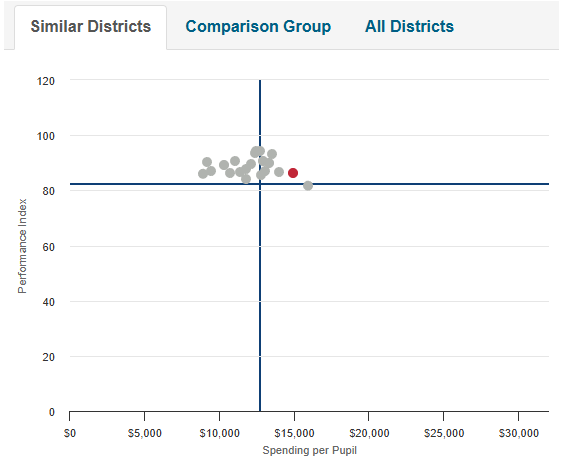
Wooster is spending quite a bit to get these results. When Ohio compares Wooster to districts it thinks are similar, Wooster spends quite a bit more for the same results. Wooster spends the most per student of any of our neighbors. Wooster also asks the local community to pay more of the district spending budget than our Wayne County neighbors. Wooster is also very large, teaching between twice to four times as many students as our neighbors.
This graph shows only districts that Ohio considers similar to Wooster:
Wooster is the red dot on this graph. It is spending significantly more than similar districts on the same horizontal line, indication more spending per student to get the same results. Wooster is to the right to the vertical line, indicating it is spending more than the State average per student.
Wooster spends $14,918 per student. The County average by district is $13,643 per student. This means Wooster spends about 110% for average results compared to the rest of Wayne County.
Wooster’s enrolment is 3,175 students. This is by far the largest in Wayne County. The next largest is Orrville with 1,412 students. The smallest is Rittman with 759 students.
Building by Building: Different Challenges and Successes
Wooster High School earned an above average score overall. It is the only place the district earns scores on graduation and future readiness. It stands out in the district as having a very low score for student yearly progress. Its spending per student is the highest in the district but not by a large amount.
Wooster High School scored 3.5 out of 5 Stars overall. Specific Scores: 3 out of 5 Stars on Achievement. 2 out of 5 Stars on Student Progress. 4 out of 5 Stars on Gap Closing
It is the only place the district is scored on Graduation Rates and Post-Graduation Readiness. 4 out of 5 Stars for Graduation Rate 3 out of 5 Stars for Post-Graduation Readiness.
Ohio reports $16,664 spent per student. This is 10% higher than the district average by building.
Edgewood Middle School earned a very high score overall. It stands out as the building with the highest student yearly progress. Its spending per student is average for the district.
Edgewood Middle School scored 4.5 out of 5 Stars overall. Specific Scores: 3 out of 5 Stars on Achievement. 5 out of 5 Stars on Student Progress. 4 out of 5 Stars on Gap Closing
Ohio reports $14,838 spent per student.
Early literacy scores only come from our four elementary schools: Cornerstone, Kean, Parkview, and Melrose
Kean Elementary earned a high score overall. It stands out as having some of the best student State test scores and the best equality based on student backgrounds. The district spends an average amount per student at Kean. Kean receives the least Federal assistance funding per student.
Kean Elementary School scored 4 out of 5 Stars overall. Specific Scores: 4 out of 5 Stars on Achievement. 3 out of 5 Stars on Student Progress. 5 out of 5 Stars on Gap Closing. 3 out of 5 Stars on Early Literacy.
Ohio reports $14,338 spent per student.
Melrose Elementary earned a high score overall. It stands out as having some of the best equality based on student background. It has the best student yearly progress of Wooster’s elementary schools. The district spends an average amount per student at Melrose.
Melrose Elementary School scored 4 out of 5 Stars overall. Specific Scores: 3 out of 5 Stars on Achievement. 4 out of 5 Stars on Student Progress. 5 out of 5 Stars on Gap Closing. 3 out of 5 Stars on Early Literacy.
Ohio reports $14,496 spent per student.
Parkview Elementary earned a high score overall. It stands out as having some of the best student State test scores. It has the best early literacy score of Wooster’s elementary schools. The district spends the most per student at Parkview of any of the elementary schools.
Parkview Elementary School scored 4 out of 5 Stars overall. Specific Scores: 4 out of 5 Stars on Achievement. 3 out of 5 Stars on Student Progress. 4 out of 5 Stars on Gap Closing. 4 out of 5 Stars on Early Literacy.
Ohio reports $15,467 spent per student.
Cornerstone Elementary earned a slightly lower than average score overall. It stands out as having critically low student yearly progress and the lowest equality by student background for the district. That said, students are scoring as well on State tests and on early literacy as the district average. Students at Cornerstone have the least spent on them per student of any building in the district.
Cornerstone Elementary School scored 2.5 out of 5 Stars overall. Specific Scores: 3 out of 5 Stars on Achievement. 1 out of 5 Stars on Student Progress. 3 out of 5 Stars on Gap Closing. 3 out of 5 Stars on Early Literacy.
Ohio reports $13,614 spent per student. [See next paragraph for more details]
Ohio’s report that Cornerstone spent the least per student of any building in the district threw a red flag for me. In fact, that is why I chose to delay the release of this piece. I reached out to Superintendent Tudor for clarification on this since it did not seem correct to me, as a parent at Cornerstone. Here is what he tracked down: 1. The expenses are pulled from the prior year (2023–2024). 2. District-level spending is divided by the total number of students. This includes positions that support all buildings—such as central office administration, literacy coaches, and coordinators. Since Cornerstone has more elementary students, the per-student share of these district-level costs appears lower than it would at a building with fewer students. 3. Some employees are funded through various sources (grants, federal/title funds, general funds). Those costs are allocated across multiple schools and can also reduce the amount reflected for any single building.
I think this illustrates something important: The scores can’t show the whole picture. How you read and interpret the data is important.
The easier the answer you get from data, the less that answer actually applies to any one actual person.
Take my daughter for example. For her 3rd grade year at Cornerstone her reading level scored above her grade level at the start of the year. By the end she was still reading above her grade level. The score also showed that she had made very little progress in reading that year. So she is contributing to Cornerstone’s critically low Progress score. But is it really a critical failure if a child is reading above their grade level? The Progress score says I should be worried about my daughter’s progress at Cornerstone. As a parent, I don’t believe this is anything to worry about for my daughter. The score doesn’t determine her personal experience.
Moving Forward: Learning How to Read the Results
During the presentation to the board, the staff mentioned several things that district was trying in order to improve results. These ranged from trying new things to ongoing programs. It struck me that most of these were focused on learning where to best focus district efforts.
New Kindergarten through 5th grade reading and math curricula are being added and enforced. There is support for teachers learning and adjusting the new materials.
“This year, our K-5 teachers have begun implementing Eureka Math² and HMH Into Reading with a strong focus on instructional integrity. Scope and sequence teams have already revised the first modules to better support teaching and learning. Multiple professional development sessions have helped build staff capacity, while teachers continue to collaborate through Teacher-Based Teams and peer support. These efforts reflect a strong, district-wide commitment to high-quality, aligned instruction.”
Principles are learning to read testing data to help direct support to where help is need. This is also being learned by department leads, and then passes down to grade level teaching teams. The yearly progress of students through grades is the main focus right now.
“Our district is strategically aligning the focus of K-12 Teacher-Based Teams to build collective teacher efficacy and strengthen instructional practice across all grade levels. This districtwide alignment ensures consistency. coherence, and a shared commitment to continuous improvement. Principals are learning to interpret value-added reports through SAS EVAAS training to better support teachers. They share this with BLTs, teachers share with TBTs, and eventually students, helping set high goals. The focus is on student growth, progress, achievement, and ensuring at least one year of academic growth for every student.”
Teachers are provided with opportunities to learn more about topics like teaching students with traumatic backgrounds, being sensitive and inclusive to students with learning challenges, and how to structure classrooms that encourage student growth.
“This year, our district is offering a diverse selection of book studies for educators, focused on key topics like classroom talk, trauma and resilience, sensory strategies, student anxiety, mathematical reasoning, inclusion, MTSS, and effective leadership. With titles such as The Anxious Generation, Lost at School, Bold School, The Way to Inclusion, and Building Thinking Classrooms, these studies support ongoing professional growth and provide practical strategies to improve teaching, learning, and student well-being.”
Testing schedules are being adjusted to better provide enough time and support for students.
“Our district is refining K-12 testing protocols to better support all learners. This includes reconfiguring schedules to increase time for small group interventions and creating testing environments that align with the Ohio Accessibility Manual. We’ve also implemented scheduling practices that ensure students with disabilities take full advantage of their extended time and appropriate supports. These efforts reflect our commitment to equitable access, meaningful assessment, and improved student outcomes.”
One example that struck me as particularly clever was a simple change that cost nothing extra and probably ended up saving money long term. This simple change cut the number of kindergarteners needing reading assistance nearly in half.
Kindergarteners take a test to determine their reading level at the start of the school year. They used to take this as part of their first day. Teachers noticed that students were put on reading assistance programs because of those test results that later turned out to be right on track later in the year. By having kindergarteners take this test later in the first few weeks the scores improved dramatically. Students needing reading assistance, and the extra time associated with that help, went from 56 to 31. In retrospect it seems obvious that giving new kindergarteners time to adjust to school life would help them take one of the first tests they have probably ever taken in their lives. Speaking from personal experience, it is not so obvious to notice that sort of thing when you are in a rush trying to get everything done.
The presentation ended with information on a grant that will help fund district literacy efforts for kindergarten through 7th grades for the next 4 years.
In K-4 Elementary Schools: “Grant funding will support targeted reading and writing interventions for students performing below grade level. These services will take place during the school day and may be expanded through after-school or out-of-school time instruction. The grant also provides high-quality professional development for teachers, literacy coaches, ML teachers, principals, instructional paraprofessionals, and library technicians. In addition, it supports training for school leaders and staff to develop, implement, and evaluate effective K-4 literacy initiatives. The work will be coordinated across early childhood programs, classroom teachers, and literacy teams, with a strong focus on engaging families and promoting home literacy practices to support student growth.”
In Edgewood Middle School: “Grant funds will support reading and writing interventions for students in grades 5-7 whose literacy skills are below grade level. Services will be provided during the school day and may be extended through after-school or out-of-school instruction. The grant also supports training for principals and staff to develop. implement, and evaluate high-quality, comprehensive adolescent literacy initiatives. Additional funding will allow for time and collaboration among teachers to plan evidence-based literacy instruction as part of a well-rounded education. This work will be coordinated across staff, principals, ML teachers, special educators, and literacy teams to ensure cohesive support for student literacy development.”
Author’s Notes:
This last year’s State report card shows a lot of general progress being made by the district. The more I looked the more I saw broad improvements. I think that is very encouraging and it indicates our children’s schools on on the right track. I’m thankful for that.






Leave a Reply